

Tax Planning Insights 2025
Year-End Edition
Dear Clients and Friends,
As Congress finalizes changes under the Reconciliation Bill, taxpayers should prepare for a mix of permanent and temporary adjustments to both personal and business tax rules. At Moceri & Company, our priority is to help you navigate these changes with clarity—both for your 2025 tax filings and your broader financial planning.
In this edition, you’ll find insights on:
- Key considerations when preparing your 2025 tax return
- The potential impact of recent tax law changes on individuals and businesses
- Practical strategies to support your year-end tax planning
If you have questions about your specific situation, please don’t hesitate to contact us.
Warm regards,
Individual Tax Changes
New Individual Benefits
Tip Income Exclusion: Up to $25,000 in qualified tips may be deductible (subject to income phaseouts).
Overtime Pay Exclusion: Up to $12,500 ($25,000 MFJ) exempt from tax.
Senior Deduction: Additional $6,000 per taxpayer over age 65 ($12,000 MFJ if both qualify).
Vehicle Loan Interest Deduction: Up to $10,000 per year for U.S.-assembled vehicles.
EV & Solar Credits: Gradual phaseout begins in 2025.
Charitable Contributions: Above-the-line deduction raised to $1,000 ($2,000 MFJ); itemizers now face a 0.5% AGI floor.
529 Plan Expansion: Covers broader education and credentialing expenses (e.g., CPE, tutoring).
New “Trump Accounts”: After-tax contributions up to $5,000 per year; converts to a traditional IRA at age 18.
SALT Deduction Cap: Raised from $10,000 to $40,000, phasing out for AGI over $500,000 (reverts after 5 years).
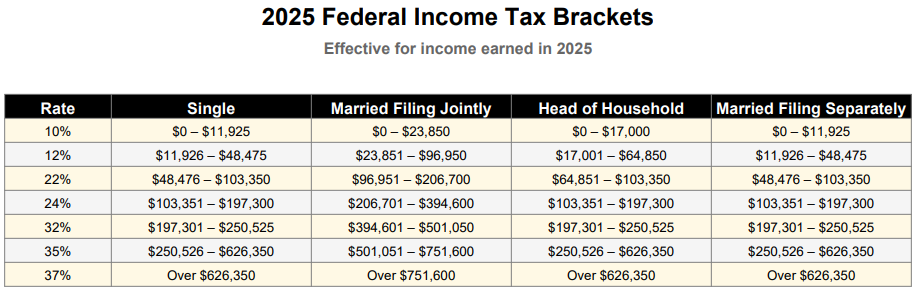
Tax Brackets
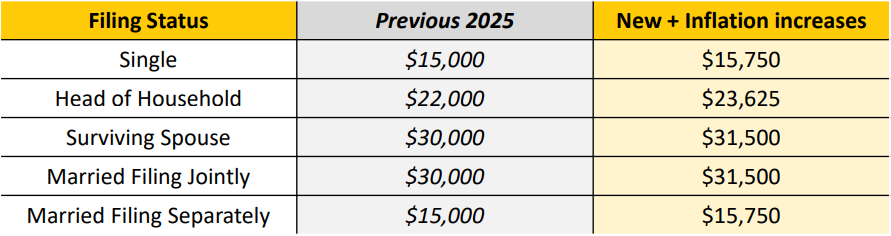
Standard Deductions (with inflation adjustments)
Other Key Provisions
Child Tax Credit: Increased to $2,200 per child
Mortgage Interest: Deduction and cap are now permanent
No deduction for interest on home equity loans used for personal use
Wagering losses: Include wagering expenses- are deductible to the extent of wagering gains (only 90% of total losses incurred)
Moving Expense: Deduction has been repealed (except for military and intelligence personnel)
Business Tax Changes
Key Provisions
Qualified Business Income Deduction: Extended permanently.
R&D Expenses: Immediate expensing reinstated for U.S. research (retroactive amendment allowed for 2022–2024).
Bonus Depreciation: Restored to 100% permanently for assets placed in service after January 19, 2025.
Section 179 Expensing:
Limit increased to $2.5 million
Phaseout threshold raised to $4 million
ERC (Employee Retention Credit):
Retroactively disallowed for Q3 & Q4 2021 if filed after January 31, 2024
Expanded audit window and penalties for refund promoters
1099 Reporting Threshold: Increased from $600 to $2,000 (effective 2026).
Interest Deduction (Sec. 163(j)): Reverts to EBITDA-based calculation beginning in 2026.
Employer “Trump Account” Contributions: Deductible up to $2,500 per employee.
Filing Tips for your 2025 Tax Return
Organize and upload your tax documents
Keep your documents grouped by type as you receive them — or better yet, scan and upload them directly through the Moceri Client Portal. It’s the fastest, most secure way to get your information to us. Missing even one document is one of the most common causes of filing delays
Review Your Child’s Income
If your child earned income in 2025, take a moment to review whether they may need to file their own tax return. Generally, a 2025 return is required if your child has earned income over $14,600 or investment income—such as dividends, interest, or capital gains—totaling more than $1,300.
Keep donation records
For cash contributions under $250, you must have a bank record—such as a canceled check, credit card statement, or receipt from the charity. For larger contributions, be sure to obtain a written acknowledgment from the charitable organization before filing your tax return.
Calculate your estimated tax if you extend
If you file an extension, you’ll need to make a quick calculation to estimate your 2025 tax liability. If you still owe the IRS, a payment must be made by April 15, 2026. Remember, filing an extension gives you extra time to file your return—but not to pay the taxes owed.